Brand identity design.
A complete identity system: the logo and every element that must remain consistent with it, from palette and typography to applications and guidelines.
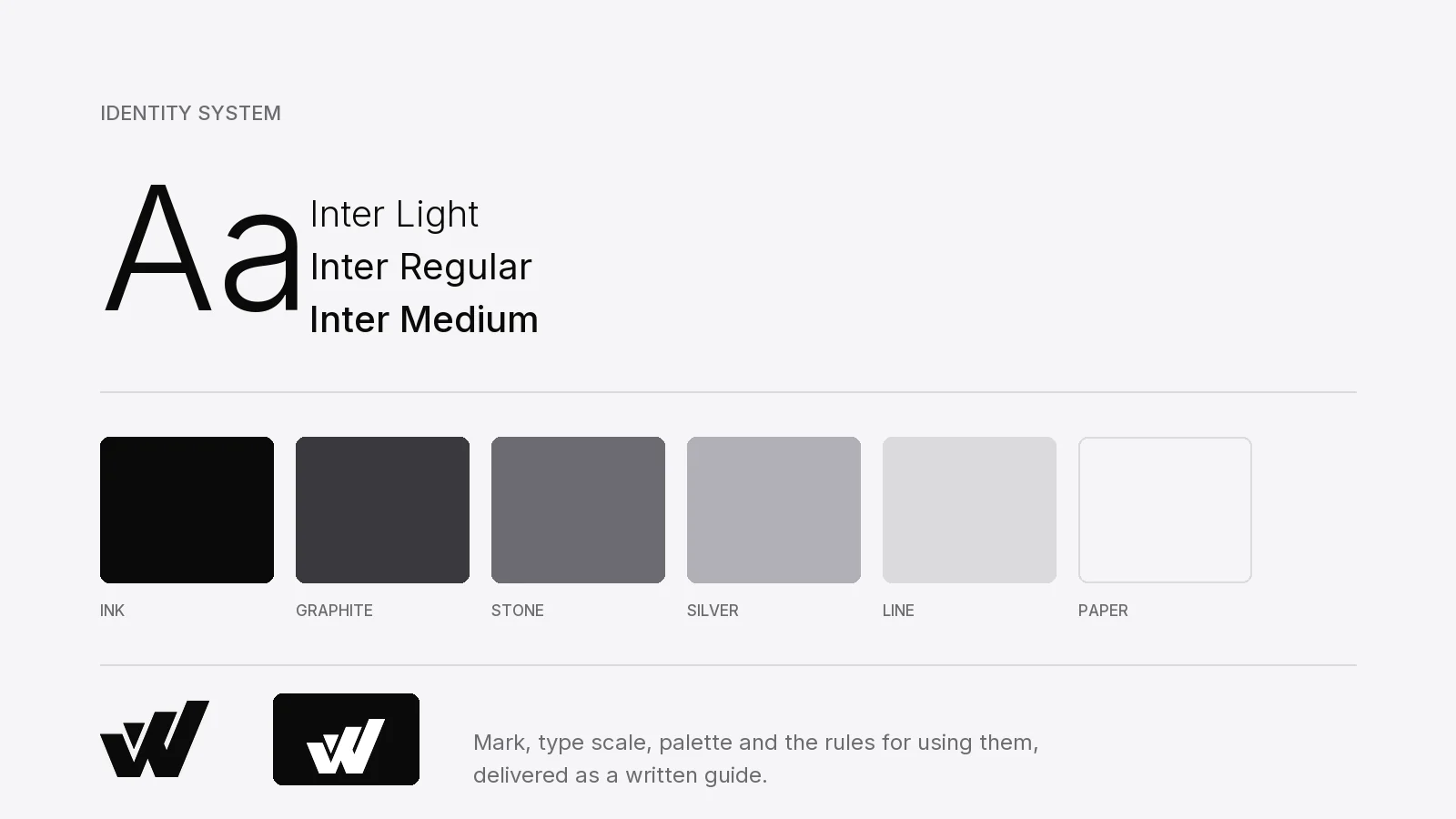
Logo
A new mark, or an existing one refined to work within the system.
Colour and typography
A palette with defined roles and typefaces selected for screen and print.
Visual system
Layout, imagery and motion principles that allow the identity to be extended consistently.
Applications
From stationery and social media templates to presentation materials.
Guidelines
A single reference document for everyone who will use the identity.
From brief to handover.
Discovery
Positioning, audience and competitive context.
Direction
One recommended route, presented in application.
System
Each element developed and tested against real material.
Handover
Files, guidelines and a working session with the team.
Frequently combined with.
Logo Design
Two fully developed directions, refined through two rounds of revisions and delivered with complete files and usage guidelines.
UI / UX Design
User flows and wireframes established before visual design, delivered as a responsive interface and an interactive prototype.
In depthBrand identity design, in depth
What a brand identity comprises
A brand identity is the set of decisions that ensures everything an organisation produces is recognisably its own. It is not a logo with a colour selected to match. It comprises a palette with defined roles; typefaces selected to perform on screen at small sizes as well as in print; principles for layout, imagery and, where relevant, motion; the applications that demonstrate the system in use; and the guidelines that allow anyone who was not part of the project to extend the system without compromising it. Executed properly, an identity is the most durable asset an organisation commissions: websites are rebuilt periodically, whereas a sound identity can serve for a decade or more.
The identity project is therefore approached as infrastructure: a system that will be used daily, by people who were not part of its creation, for many years.
Deliverables
The identity project includes the logo, either a new mark or an existing one refined to work within the system. It includes a colour palette with primary, secondary and functional roles and documented accessible combinations. It includes typography, usually one or two families, with a defined scale for headings, body text and small text across print and screen. It includes a visual system covering grid, spacing, imagery direction and motion principles where applicable. It includes a set of applications, from stationery and social media templates to presentation materials, so that the system is tested against real material before release. And it includes guidelines: a single reference document that resolves questions before they arise.
Process
The project begins with discovery: positioning, audience, competitive context, and what must change and what must be preserved. One recommended direction is then developed and presented in application, rather than a range of options without a recommendation. The system is subsequently built out element by element and tested against the agreed applications. The project concludes with handover: the files, the guidelines and a working session with the team that will use them. An identity project typically runs six to ten weeks, depending on the number of applications and the pace of client decisions.
Scope and quotation
The scope of an identity project varies with the number of applications, with naming work where a business requires a name as well as a mark, and with the depth of guidelines required by larger organisations. Every project is quoted in writing before work begins. Organisations that go on to commission a website from the studio find that the identity work reduces the design phase considerably, because the decisions a website designer would otherwise need to make have already been documented.
Refreshes and rebrands
Not every identity project begins from nothing. A refresh retains the recognisable elements of an existing brand and corrects what no longer performs: an inconsistent palette, a typeface not licensed for digital use, or a logo that fails at small sizes. A rebrand goes further and is usually prompted by a change in the organisation itself. Both are scoped following a short audit of the existing material.
Guidelines that are used
Most brand guidelines are read once and set aside. Ours are written to be used: concise, visual, and organised by the questions users are likely to have rather than by element. Each section shows the rule, a correct example, an incorrect example, and a reference to the file or template that makes correct use the simplest option. The document is delivered as a PDF and as a shared web page that can be updated as the brand develops, so that the current version is always the one in circulation.
Applications
The applications included in an identity project are agreed with the client according to what the organisation actually produces. For most businesses this comprises business cards and letterhead, an email signature, social media profile and post templates, a presentation template, and the website's design language. For product businesses it extends to packaging and labelling; for physical premises, to signage and vehicle livery; for events and hospitality, to menus, badges and printed collateral. Each application serves as a test of the system as well as a deliverable.
Timeline
Discovery occupies the first one to two weeks, depending on the number of stakeholders. The direction is presented in week three or four. The system and applications occupy the middle of the project, and guidelines are written as the system is finalised so that they reflect the decisions actually taken. Handover is conducted as a working session.
Starting a project
Enquiries can be submitted through the contact form, selecting brand identity, or by email to hello@walkupdigital.com with a description of the business and the intended timeline. We respond within one working day. Where appropriate, a consultation follows, after which we issue a written proposal covering scope, timeline and terms.