Logo design.
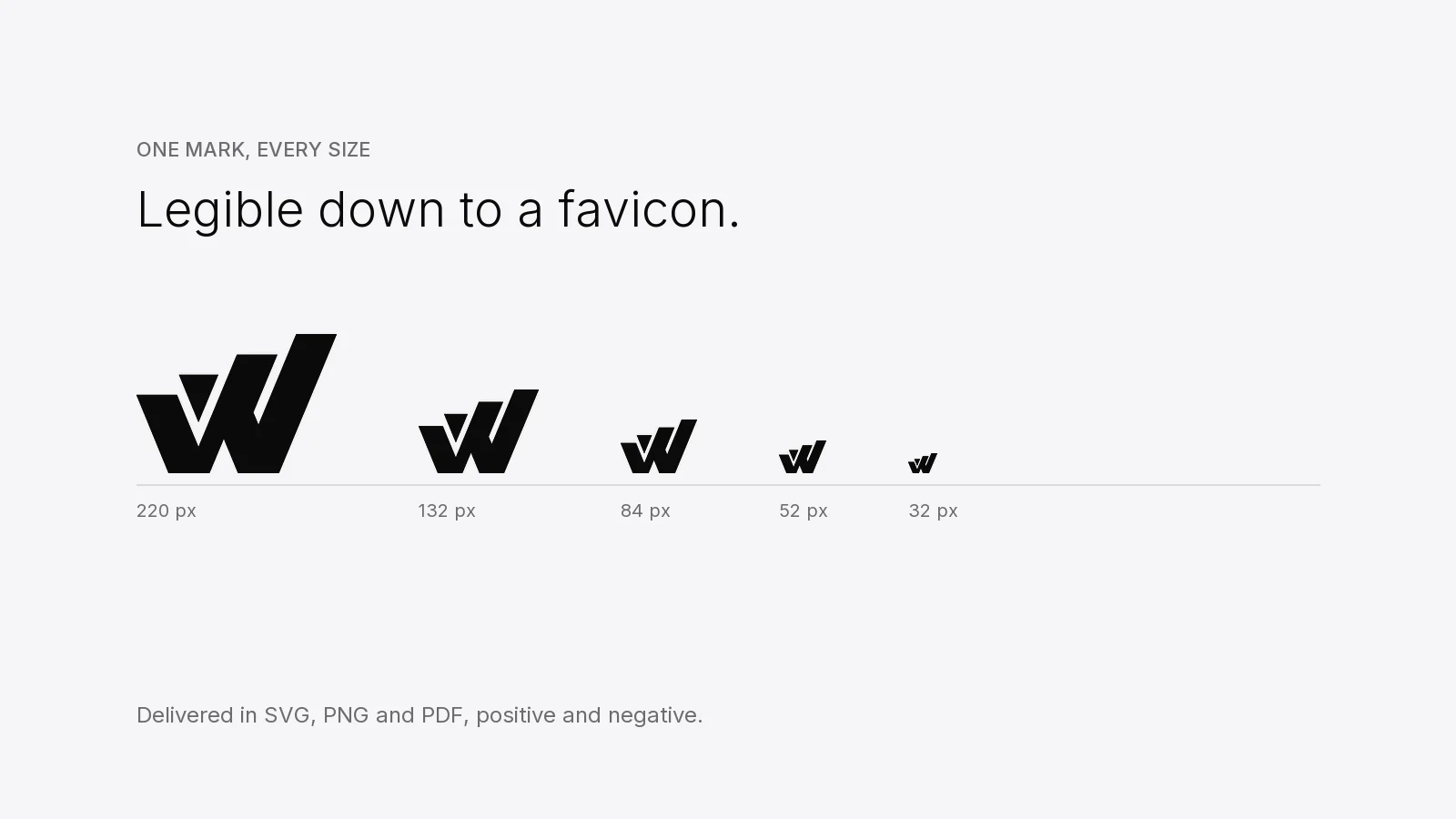
A mark designed to remain legible and distinctive at every size, developed through two complete directions and delivered with the files and guidance required to use it consistently.
Two directions
Two distinct, fully resolved directions, presented in context.
Two rounds of revisions
Refinement of the selected direction, followed by final approval.
Complete exports
Vector and raster files in colour, monochrome and reversed versions, at every required size.
Usage guidelines
Clear space, minimum sizes and correct application, documented on a single page.
From brief to handover.
Brief
The business, its audience and the contexts in which the mark will appear.
Directions
Two marks presented on real surfaces: screen, print and signage.
Delivery
Revisions, final files and guidelines.
Frequently combined with.
Brand Identity
A complete identity system: logo, colour palette, typography, visual language, applications and brand guidelines.
Web Development
Custom-built websites with a content management system, forms, analytics and deployment, engineered for performance and maintainability.
In depthLogo design, in depth
The function of a logo
A logo has a single function: to be recognised. It must remain legible and distinctive at the size of a browser icon and at the scale of signage, in full colour and in a single ink, to an audience that may have encountered it only once. Our approach follows from this requirement. We develop two complete directions rather than a large number of variations, present each on real surfaces rather than in isolation, and refine the selected direction with the client, so that the people who will represent the mark within the business have shaped it.
Deliverables
A completed logo project delivers the mark in every form in which it will be used: vector files for print and signage; raster files at every practical size for digital use; horizontal and stacked lockups and the mark alone; full-colour, single-colour and reversed versions; a square version for social profiles; and a browser icon set. It is accompanied by a single-page guideline document specifying clear space, minimum sizes and correct application, so that the mark is reproduced consistently by printers, sign-makers and internal teams.
Process
The brief is conducted as a structured conversation covering the business, its audience, its competitive context and the impressions it wishes to avoid. Two directions are then developed, each presented as a complete mark in context: on screen, on stationery and on signage. The client selects one direction, which is refined through two rounds of revisions before final approval. The project concludes with the delivery of all files and guidelines and a short handover. Most logo projects are completed within three to four weeks; the timeline is determined largely by the speed of client decisions.
Scope and quotation
The standard project covers the scope described above. Additional directions, further applications such as stationery or vehicle livery, and trademark-readiness work where a mark must be cleared before finalisation are scoped separately. Every project is quoted in writing before work begins. Where the client also requires the palette, typography and wider system, the brand identity project includes the logo and represents the more complete engagement.
Existing marks
Many organisations approach us with an existing mark and an incomplete or unusable set of files. In such cases the appropriate project is often a refinement rather than a redesign: correcting the geometry, redrawing the mark as clean vector artwork, resolving its behaviour at small sizes, and producing the exports and guidelines that were never prepared. This is scoped as a smaller engagement.
Naming and wordmarks
Where a business requires a wordmark alongside or instead of a symbol, the typeface is selected or drawn to perform at the same range of sizes and applications. Where a name has not yet been decided, naming is scoped as a separate engagement preceding the logo project, since the mark should follow from the name rather than the reverse.
Formats and colour
For print, the mark is delivered as vector artwork in CMYK and, where applicable, as a spot colour, scalable without loss of quality. For screen, it is delivered in RGB, as SVG for sharp rendering at every pixel density and as PNG where SVG is not supported. Colour values are documented in every system a supplier may require: HEX, RGB, CMYK and the nearest Pantone equivalent. Where the mark incorporates a wordmark, the type is either converted to outlines or drawn from a typeface whose licence covers the intended use, and this is stated in the guidelines.
Common questions
How many revisions are included? Two rounds on the selected direction, which in practice is sufficient because the direction is chosen from finished work rather than from sketches. Are source files provided? Yes, in full, in the original vector format. Can existing brand colours be retained? Yes, and we will advise if they do not perform at small sizes or fail accessibility contrast requirements. Is trademark clearance included? We conduct a visual search for evident conflicts as part of the work; formal clearance and registration are undertaken by a trademark attorney, and we provide the files required for that process.
Timeline
Brief in the first week; two directions in the second; revisions in the third; final files and guidelines in the fourth. Projects proceed more quickly when decisions are returned within one to two days, and more slowly where a mark must be approved by a committee, which is worth establishing at the outset.
Starting a project
Enquiries can be submitted through the contact form, selecting logo design, or by email to hello@walkupdigital.com with a description of the business and the intended timeline. We respond within one working day. Where appropriate, a short consultation follows, after which we issue a written proposal covering scope, timeline and terms.
Ownership
On completion of the project and settlement of the final invoice, all rights in the mark and its files transfer to the client. The studio retains no licence over the work and does not use it in its own materials without prior written consent.